|
|
|
|

|
The Anchorage
Mr Oliver Burbage-Hall
BY FAX AND BY FIRST CLASS POST 3 August 2001
Our ref: EB/WNB/P1420/TBA
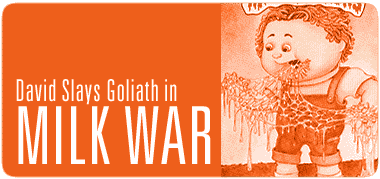
Dear Sir CASE NUMBER B01-05135/OBH/dw PEOPLE FOR THE ETHICAL TREATMENT OF ANIMALS - "MILK SUCKERS" CAMPAIGN We are instructed by PETA Europe Limited ("PETA") to respond to the Authoritys draft recommendation forwarded to PETA under cover of your letter dated 27 July 2001. PETA is disappointed to note that the Authority has decided to uphold the complaints raised. However, it is grateful for the opportunity to respond to the draft recommendation and trusts that, on reviewing this response to the draft recommendation, the Authority and the ASA Council ("the Council") will elect to dismiss the various complaints that have been raised. The principle underlying PETAs "MILK SUCKERS" campaign Prior to commenting upon the Authoritys draft recommendation in detail, it is worthwhile reiterating PETAs position in relation to the human consumption of dairy milk and the principles underlying the "MILK SUCKERS" campaign. PETAs "MILK SUCKERS" campaign attempts to draw childrens attention to the dangers of dairy milk consumption in a light-hearted and amusing fashion. It is PETAs position, which is endorsed by a substantial body of scientific research and by many leading paediatricians and physicians over the years, that nature did not make a mistake in creating rat milk for baby rats, dog milk for baby dogs, human milk for baby humans and cows milk for calves. It is PETAs firm belief that human beings should not attempt to defy nature by consuming dairy milk as the fat content and foreign animal proteins and dioxin contained within dairy milk can have an adverse affect on human health both in the short and long term. This was the fundamental message which PETA was attempting to relay to children through its light-hearted but thought provoking "MILK SUCKERS" campaign. There are only five complainants. Of these, four are powerful organisations involved in agriculture who benefit from milk sales. PETA would be interested to know whether the member of the public who raised a complaint also has links with the dairy industry. NFU Services, the National Farmers Union of Scotland, the Royal Agricultural Society of England, and the Dairy Council have all been involved in promoting the sale of milk. It is therefore in their commercial interests to stop PETAs campaign. By contrast, PETA is a charity and achieves no financial gain from this campaign. PETA is simply wanting to challenge the orthodox beliefs about cows milk. There is nothing for PETA to gain in promoting a campaign that has no scientific support. The Council is therefore faced with questions of conflicting ideologies and freedom of speech. It will therefore be important for the Council to consider the precise complaints made and to consider the cards impact in this context. It is also important to note that PETA has not seen the complaints made against the cards, nor the evidence, if any, on which the complainants rely. The Authoritys draft recommendation
We now turn to each of the complaints upheld within the Authoritys draft recommendation:-
The First Finding NFU Services - the National Farmers Union of Scotland, the Dairy Council and the Royal Agricultural Society of England challenged the advertised claims that dairy milk caused acne, obesity, flatulence and excess phlegm in children.
PETAs response First and foremost, PETA feels that the burden of showing that most children will be put at risk by consuming dairy products has been overwhelmingly met, as will be explained below. Many paediatricians, including Dr. Charles Attwood, Dr. Benjamin Spock, and Dr. Frank Oski, among the most notable, believe that dairy milk is harmful for all human beings, including children (see below). However, PETA does not agree with the Authoritys finding that the wording of the "MILK SUCKERS" cards indicate that most children will develop these conditions, or that children will read them that way. The "MILK SUCKERS" campaign was designed to alert children in a light-hearted and comical fashion to the conditions that can be caused by the human consumption of dairy milk. PETA does not accept that children reading the "MILK SUCKERS" cards would automatically conclude that they would contract any of the various conditions caricatured (wind, acne, obesity and excessive phlegm). PETA considers that children would upon reading the cards be alerted to the conditions that can be caused through daily milk intake and reconsider the merits of daily milk consumption. The overall impression created by PETAs "MILK SUCKERS" cards is not that dairy milk consumption will automatically trigger these specific conditions in all children but only that there is a likelihood that dairy product consumption may cause such specific conditions in some children. This is reflected in the wording that appears on the reverse of PETAs cards. For example, the Windy Wendy card states: "Hey, who guffed? Maybe you, if youre one of the millions of people who are lactose intolerant. Milk might make people intolerant of you because one of the symptoms is pardon us wind". Similarly, PETAs Spotty Sue card states: "..Humans can have all sorts of gross reactions to cows milk " In support of the contention that the Authority has asked PETA to justify (i.e. that most children who drank dairy milk suffered from acne, obesity, flatulence and excess phlegm) the Authority has only sought to rely upon claims within the text of the Chubby Charlie and Phlegmy Phil cards. However, as we have highlighted above, it is PETAs position that none of its "MILK SUCKERS" cards is as categoric in context as the Authority maintains. With respect, the Authority needs to consider the content of each "MILK SUCKERS" card individually in reaching its decision as to whether each card is acceptable under the Code. Accordingly, should the Authority decide to uphold the complaints in relation to one of the "MILK SUCKERS" cards it does not automatically follow that the complaints should also be upheld in relation to the remaining cards. In any event, PETA considers that it would have been misleading to understate the dangers of milk and dairy product consumption by children (and adults) which have been highlighted by a number of world renowned paediatricians including:-
It appears from the draft recommendation that because the Authority felt that the evidence provided by PETA did not show that "most" children who drank dairy milk suffered from acne, obesity, flatulence and excess phlegm, the Authority concluded that the claims made on the "MILK SUCKERS" cards were unacceptable. PETA considers this evidential burden of proof to be excessive, onerous and inconsistent with the Authoritys advertising code ("the Code"). It also does not reflect a fair interpretation of the cards when viewed in their context and their intended audience. By way of analogy, PETA fails to understand why it is perfectly acceptable for the anti-smoking lobbies to make claims in advertisements that "SMOKING CAUSES LUNG CANCER" when in fact medical research has proven that only 15% of smokers will contract lung cancer, but it is unacceptable for PETA to claim that a childs dairy milk consumption can give rise to such conditions as flatulence, obesity and acne when there is overwhelming expert endorsement of such claims. In the same way as smokers can contract lung cancer, dairy milk consumption by children, whilst not always leading to these ailments, is inextricably linked to gastrointestinal distress, acne, phlegm and other allergic reactions and removing milk from the diet is more than likely to help most children to alleviate some of these symptoms. Finally, the test which the Authority has set for PETA to meet does not match the complaint. It exceeds it significantly. The complainants have only challenged the claim that milk causes the relevant ailments. PETAs evidence shows that it does cause them. There was no quantative element to the complaint and no quantative element to the text on the cards. With respect, it is not then for the Authority to test the cards against claims and complaints which have not been made. Conclusion PETA has provided the Authority with conclusive evidence from well respected leading paediatricians and physicians to support its the view that all children (and adults) should avoid dairy milk consumption due to the adverse medical conditions to which it can contribute. PETA considers that it has more than satisfied this evidential burden to prove the causal link between dairy product consumption by children and the conditions highlighted on the "MILK SUCKERS" cards. It is inappropriate for the Authority to impose upon PETA to expect it to provide conclusive evidence to the Authority which proves that "most" children who drank dairy milk developed the conditions referred to on the cards. The cards do not make this claim and the complainants have not interpreted the cards to suggest this. The Second Finding A member of the public objected that the cards were irresponsible, because they encouraged children to stop drinking dairy milk which had proven nutritional benefits.
PETAs response As we have outlined in our response to the First Finding above, many of the worlds foremost paediatricians agree with PETAs contention that dairy milk consumption can be harmful for most, and probably all, children and should be avoided. There is overwhelming expert opinion which supports PETAs view that dairy milk consumption causes harm to children and adults. Although PETA has chosen to address issues of particular concern to children (spots, wind, obesity, allergies) and has shown, based on conclusive evidence that has not been disputed, that dairy products are linked to these ailments, since the Authoritys second finding addresses the issue of harm more generally, PETA would draw the Authoritys attention to the two diseases that kill the most people in the United Kingdom which are also linked to dairy milk consumption, namely heart disease and cancer. The link between dairy milk consumption and heart disease and cancer has been confirmed by leading authorities on such matters. For example, Dr. T. Colin Campbell, of Cornell University, director of the China Study (called by the New York Times "the most comprehensive large study ever undertaken of the relationship between diet and the risk of developing disease") and arguably the top epidemiologist in the world, states that "the vast majority of all cancers, cardiovascular diseases, and other forms of degenerative illness can be prevented simply by adopting a plant-based diet" (quoted in The New Food Revolution , 2001, John Robbins, p. 39). Similarly, the World Health Organizations Report on Diet, Nutrition, and the Prevention of Chronic Diseases , states "A substantial amount of epidemiological and clinical data indicates that a high intake of plant foods and complex carbohydrates [there is no complex carbohydrate in dairy products or meat] is associated with a reduced risk of several chronic diseases, especially coronary heart disease, certain cancers, hypertension, and diabetes." Taking heart disease and cancer in turn, PETA would draw the Authoritys attention to the following:- Heart Disease By far the biggest killer in the UK is heart disease (coronary artery disease, also, kills proportionately more people in the UK than anywhere else in the world), and arterial clogging begins as early as the age of two. PETAs web site (www.milksucks.org.uk) lists a dozen studies, some of them meta analysis studies, which show that the single greatest causal factor for heart disease is dairy milk consumption. By way of example, in a study published in The Lancet , researchers comparing heart disease death rates with food intake found that the highest correlation was with milk. "Changes in milk-protein consumption, up or down, accurately predicted changes in coronary deaths four to seven years later." The researchers noted that their analysis "strongly supports" previous conclusions that milk is the principle dietary culprit in hardened, narrowed arteries. Dr. Atwood points out in A Vegetarian Doctor Speaks Out that most adults have coronary occlusions at age 21 (p. 4). In contrast, vegans (vegetarians who do not consume dairy products) of the same age were shown to have clear arteries. (p. 109). He suggests that "the fact that 4,000 people die every day in North America from preventable disease gets no attention at all. If a preventable industrial accident were killing this many people, something would be done" (p. 5) and points out the obvious, that "the most damaging source of saturated fat available to children is undoubtedly milk and dairy products," (p. 14) and "eliminating cows milk is necessarily the hallmark of any meaningful program for reducing dietary fat in children to 10-15 percent of calories, and preventing coronary artery disease" (p. 16). He also discusses in depth the obesity epidemic among milk-drinking children, arguing that milk is the primary cause. Doctors Caldwell Esselstyn (Cleveland Clinic) and Dean Ornish (Preventive Medical Research Institute), are the worlds top two heart researchers and the only two physicians ever to unclog human arteries, making them "heart attack proof" (Esselstyn, www.vegsource.com/esselstyn/). Both of them recommend that the ideal amount of cows milk for all human beings is none. All heart disease charities agree that heart disease is largely preventable, and the top recommendations for preventing the disease are remarkably similar. For example, the British Heart Foundation states, "The most important thing to remember is to cut down on foods that contain a lot of saturated fat (like dairy products ). Saturated fats increase the amount of cholesterol in your blood - and the higher your level of cholesterol, the greater your risk of heart disease. Have five portions of fruit and veg a day Eat more fibre try pasta, bread and potatoes." The American Heart Association states, in its "Dietary guidelines for healthy children," 1) "Select, prepare and eat foods low in saturated fat, cholesterol and total fat." 2) "Choose a variety of foods to be sure you get enough carbohydrates, protein and other nutrients." 3) "Eat only enough calories to maintain a healthy weight for your height and build." Nutritional researcher Dr. Gill Langley explains, "Milk and other dairy products account for more than a third of the saturated fats eaten in [the UK] (meat contributes another quarter), and the UK has the highest level of heart disease in the world" ( Vegan Nutrition , 1995, p. 177). Cancer Cancer is the number two killer in the UK, and the evidence is overwhelming that milk consumption both causes the disease and speeds cancer growth. For example, Dr. T. Colin Campbell, cited above, suggests ("Chemical Carcinogens: How Safe Are You?", www.NewCenturyNutrition.com) that "human studies also support this carcinogenic effect of animal protein, even at usual levels of consumption" (emphasis in original) and that "no chemical carcinogen is nearly so important in causing human cancer as animal protein." It is important to point out not just that fat and protein in milk clogs up the arteries, but also that the animal protein and dioxin that builds up in the animals milk also lead to cancer (dioxin information from a report by the U.S. Environmental Protection Agency, June 2000). There is a consensus among groups (e.g. the Imperial Cancer Research Fund (www.imperialcancer.co.uk), The American Cancer Society (www.cancer.org), the American Institute for Cancer Research (www.aicr.org), and the World Cancer Research Fund (www.wcrf-uk.org)) that 30-40 percent of cancer is related to diet. The top dietary recommendations, consistently, are to consume more fibre (milk is devoid of fibre) and less fat. Even "2 percent"skimmed milk derives 35 percent of its calories from fat (see www.gaylea.com/consumer/lacteeze.html ), while whole ("4 percent") milk is 50 percent fat. As indicated above, dairy products are the number one source of fat in the diets of Britons. The Imperial Cancer Research Fund states on its web site: "Scientists at Imperial Cancer Research Fund have estimated that 30% of all cancers may occur as a result of our diet a healthy diet can also help to prevent against diseases such as obesity, heart disease and hypertension." The Funds top three diet recommendations are: "Your diet should include: A high proportion of fruit and vegetables - at least 5 portions per day (A portion is approximately 120 grams or 4 ounces). A high proportion of high fibre foods such as wholemeal bread and other cereals. Avoid large amounts of fatty foods and sugar." The World Cancer Research Fund has sponsored, Food, Nutrition, and the Prevention of Cancer: A Global Perspective which states: "The panel estimates that recommended diets, together with maintenance of physical activity and appropriate body mass, can in time reduce cancer incidence by 30 - 40%. At current rates, on a global basis, this represents 3 - 4 million cases of cancer per year that could be prevented by dietary and associated means." Of 14 dietary recommendations, numbers 1, 4, 5, and 8 argue for more plant based and fewer animal based foods. For example, from number 1: "Populations to consume nutritionally adequate and varied diets, based primarily on foods of plant origin. Choose predominantly plant-based diets rich in a variety of vegetables and fruits, pulses (legumes) and minimally processed starchy staple foods." and number 8, "Limit consumption of fatty foods, particularly those of animal origin." Conclusion As indicated above, some of the worlds foremost paediatricians agree with PETA and have published widely their concerns, that dairy milk is harmful to human beings. It is therefore entirely unclear to PETA how it is irresponsible to discourage someone from doing something that is likely to cause them spots, wind, obesity, or allergic reactions, even were the risk slight (which it is not). The Authority has not asserted that dairy products have some benefits that should be promoted. Nor has the complainant. However, the Authoritys draft recommendation is based on the same unsupported assumption as the complainant that consuming milk is good for children On the basis of the evidence which it has provided to the Authority and in the absence of any evidence to the contrary, PETA is at a loss to understand why it is irresponsible of it to warn children of some of the conditions which can be directly attributed to dairy milk intake. Since no party has, to the best of PETAs knowledge, asserted any benefits of milk consumption (which PETA would refute entirely), PETA does not accept the Authoritys finding that its "MILK SUCKERS" campaign irresponsibly encouraged children to stop drinking milk. The Authority needs to be careful not to be the judge of the medical issues outside its expertise. PETA would therefore respectfully urge the Authority to reconsider its second finding that the "MILK SUCKERS" campaign irresponsibly encouraged children to stop drinking milk. The Third Finding NFU Services, the National Farmers Union of Scotland, the Royal Agricultural Society of England and a member of the public objected that the cards played on childrens anxieties and caused undue fear and distress to children.
PETAs response PETA is perplexed by the Authoritys finding that, because the images on the cards appeared with written descriptions of the conditions on the reverse of the cards, the cards played on childrens anxieties and were likely to cause undue fear and distress to some children. More than 100,000 cards have been distributed to children within the US and the United Kingdom since the campaign began in September 2000. PETA has not yet encountered a single instance of a child being in anyway upset or alarmed by the cards (whether unduly or not). In fact the cards were first distributed as an insert in PETAs child-focused magazine, Grrr, which was sent to children and classrooms in the US and UK. In that mailing alone, more than 50,000 cards were distributed, with no complaints. It was at that point that PETA began distributing the cards separately in the US and UK, still without a single complaint of distress or fear. Furthermore, to the best of PETAs knowledge, neither the Authority, nor the complainants, have provided any evidence in support of the view that any children have been caused distress or fear as a result of the "MILK SUCKERS" campaign. PETA is pleased to note that the Authority agrees with PETA that "on their own, the images were unlikely to cause undue fear and distress to children," but is perplexed that the reason the Authority concluded that the cards were likely to cause fear and distress was that the images were accompanied by text. There is no indication of what part or parts of the text the Authority finds likely to cause fear and distress. PETA does not understand how the cards could cause any fear or distress whatsoever. The absence of any prior complaint supports this view. In reaching its finding the Authority has failed to take into account that the text on each "MILK SUCKERS" card is written in a way that is amusing, fun, and interesting and in a manner which is designed neither to upset or offend children. PETA is therefore extremely surprised that the Authority has reached its conclusion. PETA considers that there is no evidence to support such an assumption and would urge the Authority to reconsider its finding in this respect. In the event that the Authority fails to reconsider its position on this matter PETA would ask for the Authoritys further clarification on this point together with an opportunity to respond to any clarification provided. Would any distress caused be "undue"? As PETA has stated previously, children should be allowed to make up their own minds on this subject. As discussed above, PETAs cards are factually accurate, urge avoidance of a product that is harmful for children, and do so in a way that is amusing, rather than alarming. In any event, even if evidence had been produced to the Authority to suggest that PETAs "MILK SUCKERS" campaign caused fear and distress to certain children, PETA would argue that its campaign cards fully satisfied code 9.2 of the Advertising Code namely that:
In the unlikely event that a child was caused fear or distress by PETAs, "MILK SUCKERS" cards it is PETAs position that any the fear caused would be entirely proportionate to the scientifically proven health risks associated with dairy milk consumption. Conclusion PETA remains perplexed as to how any aspect of its "MILK SUCKERS" cards could cause the Authority to rule that its cards are likely to cause undue fear and distress to children, without a single example of distress or fear being provided. The Authority has failed to take into account the fact that its "MILK SUCKERS" cards have been distributed to tens of thousands of children throughout the US and United Kingdom. This has been widely reported in the press but not one article has yet to raise such concerns or report upon any instance of child fear or distress caused by PETAs "MILK SUCKERS" campaign. In any event, PETA would argue even if its "MILK SUCKERS" campaign had aroused a certain level of fear or distress in children the fear or distress aroused would have been entirely proportionate to the proven health risks associated with dairy milk consumption. Summary PETA trusts that the evidence it has submitted will persuade the Council to reverse the draft recommendation. Upon reviewing PETAs additional evidence, it is confident that the Council will agree that PETAs "MILK SUCKERS" campaign was a light-hearted way to inject some much-needed truth into the nutritional debate pertaining to dairy milk consumption. PETA is more than happy to answer any further questions which the Authority may have in relation to this matter or to provide further evidence confirming the deleterious health consequences to human beings of dairy milk consumption. Yours faithfully Nabarro Nathanson
|

|
|
|
PO Box 3169, London SW18 4WJ; |
|