|
|
|
|

|
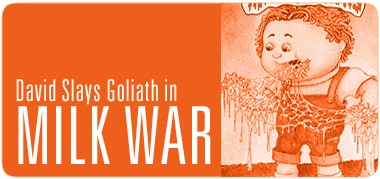
General Response to Specific Codes 2.2 All advertisements should be prepared with a sense of responsibility to consumers and to society. When preparing the Milk Suckers campaign it was, and remains, our intention to alert consumers to the inherent dangers of dairy products. We feel that it is irresponsible to promote the consumption of dairy products as being healthy when there is ample evidence to show that dairy products are detrimental to health. 2.6 Any unreasonable delay in responding to the ASA's inquiries may be considered a breach of the Codes. PETA Europe have done their utmost to ensure that this complaint be dealt with in the time frame given, although due to our never receiving the original document from the ASA and a changeover of staff in our London office we required additional time to complete this document. We appreciate the extra time granted us by the ASA. 3.1 Before submitting an advertisement for publication, advertisers must hold documentary evidence to prove all claims, whether direct or implied, that are capable of objective substantiation. Relevant evidence should be sent without delay if requested by the ASA. The adequacy of evidence will be judged on whether it supports both the detailed claims and the overall impression created by the advertisement. Before launching its Milk Suckers campaign, PETA undertook research concerning the dangers and cruelties of the dairy industry. Much of this research was already on PETAs Milk Sucks Website ( www.MilkSucks.com ) with additional information added regularly throughout the campaign. Research drawn from reputable scientific and medical institutions and published articles from doctors and scientists substantiate the claims made on the Milk Suckers cards (detailed documentary evidence can be found in the latter part of this document in the section dealing with the specific complaints relating to the accuracy of the claims made). 6.1 Advertisers should not exploit the credulity, lack of knowledge or inexperience of consumers. Far from exploiting consumers, PETA seeks to redress the imbalance in information available to consumers resulting from dairy industry propaganda and advertisements stating that dairy products are good for you. PETA want consumers to see the evidence relating to lactose intolerance, allergies, heart disease and more that researchers have clearly linked to dairy products and to show that there are readily available non-dairy alternatives that meet the bodys nutritional requirements without the unpleasant side effects accompanying dairy products. PETA feel that consumers should always have access to, and be presented with, all the facts so that they can make an informed decision about what they consume. 7.1 No advertisement should mislead by inaccuracy, ambiguity, exaggeration, omission or otherwise. The information presented on the Milk Suckers cards seeks to educate, in the limited space available on each card, based on research showing the dangers of dairy consumption and the specific links to dairy consumption and obesity, flatulence, acne and excess mucus. Each card lists the Milk Sucks website ( www.MilkSucks.co.uk ) which features detailed explanation and supporting evidence for the claims made on each card. 9.1 No advertisement should cause fear or distress without good reason. Advertisers should not use shocking claims or images merely to attract attention. PETAs Milk Suckers cards were designed to educate children to the "other side" of the dairy debate in a way which was fun and accessible to them. Created as a parody of the very popular Garbage Pail Kids cards, our Milk Suckers cards appeal to childrens sense of humor. During the course of this campaign thousands of these cards have been distributed at schools in North America and the United Kingdom and no child has ever expressed fear or distress at seeing them. The Milk Suckers cards use familiar imagery to address this very serious issue in a lighthearted way. However, we feel that if there are those who would seek to challenge this, then British Code of Advertising 9.2 ( Advertisers may use an appeal to fear to encourage prudent behavior or to discourage dangerous or ill-advised actions; the fear likely to be aroused should not be disproportionate to the risk ) would be applicable in this instance, since there is ample evidence to suggest milk consumption is ill-advised from both a health perspective (especially for the large number of people who are lactose intolerant) and from an animal welfare perspective (something of great concern to many Britons, especially children) and that the light hearted images used on the cards are, if anything, understatements to the risks posed and cruelty perpetrated by dairy consumption. 47.1 The way in which children perceive and react to advertisements is influenced by their age, experience and the context in which the message is delivered. The ASA will take these factors into account when assessing advertisements. The Milk Suckers campaign was tailored to appeal to children in the 10 to 12 year age range, but we have found that children as young as 5 or 6 find the cards appealing and their message accessible. The cards were distributed outside school gates at the end of the school day so as not to interfere with the childrens schoolwork. Children are accustomed to seeing images of this nature in the schoolyard on the Garbage Pail Kids cards.
47.2 Advertisements and promotions addressed to or featuring children should contain nothing that is likely to result in their physical, mental or moral harm:
b) they should not be shown in hazardous situations or behaving dangerously in the home or outside except to promote safety. Children should not be shown unattended in street scenes unless they are old enough to take responsibility for their own safety. Pedestrians and cyclists should be seen to observe the Highway Code c) they should not be shown using or in close proximity to dangerous substances or equipment without direct adult supervision. Examples include matches, petrol, certain medicines and household substances as well as certain electrical appliances and machinery, including agricultural equipment d) they should not be encouraged to copy any practice that might be unsafe for a child. a) Unlike the Garbage Pail Kids the Milk Suckers cards are not part of a "collection" since although there are four cards in the series, all four cards were distributed free of charge and available to any child who wanted them. b) None of the Milk Suckers cards show children in dangerous, hazardous or unsupervised situations, or encourage children to mimic the scenes on the cards, indeed no child would likely want to do so. However, the dairy industrys own classroom posters, cartoon characters, booklets, and other in-school promotions (e.g., "design a new look for an existing dairy product," Dairy Council press release, June 06, 2001) are focused on promoting dairy consumption, which can be hazardous to childrens health. c) None of the Milk Suckers is shown in close proximity to dangerous substances or hazardous situations. d) The Milk Suckers cards are asking children to seek alternatives to dairy products, since these products have been shown to be unsafe for many childrens long- and short-term health. Substantiation for this can be found in the section addressing the specific complaints. Therefore, the cards discourage the unsafe practice of dairy consumption. As with 47.2.b, the dairy industry is encouraging the unsafe practice of dairy consumption with its in-school promotions.
47.3 Advertisements and promotions addressed to or featuring children should not exploit their credulity, loyalty, vulnerability or lack of experience:
As per response 6.1, the Milk Suckers cards are educative. The information relating to the health risks of dairy consumption are especially important for children since they are particularly susceptible to dairys ill effects. Children are also the consumers most heavily targeted by the dairy industry, with milk promoted heavily in schools (just this year, the Dairy Council has produced a series of 5 "brightly coloured posters," a booklet with "streetwise cartoon characters, trendy graphics and teen-talk," and a contest to redesign, market, and advertise an existing dairy product). Children should be allowed to make informed decisions too. To address specific points: a & b) Unlike the dairy industry, PETA are not selling a product. c) There is no product involved in the Milk Suckers cards and the situations shown are depicted in a "cartoon" context.
d) The purchase of complex or costly goods is not relevant.
Detailed Response to Complaints 1. NFU Services, the National Farmers Union of Scotland and the Dairy Council challenged the advertised claims that dairy milk caused acne, obesity, flatulence and excess phlegm in children.
In substantiating the claims made on the Milk Suckers cards and dispelling to the myths surrounding the consumption of dairy products, we explore each of the themes appearing on each card.
Chubby Charlie: Obesity Doctors and dietitians have long known that high-fat foods like dairy products contribute to obesity for a variety of reasons. First, fat is calorically dense. Gram for gram, fat has more than twice the calories of carbohydrates. That bowl of ice cream has far more calories than an equal amount of grains, beans, fruits or vegetables. Second, our bodies store fat more readily than carbohydrates. Carbohydrates are fuel and are burned up easily. Fat, on the other hand, turns into fat and makes those who eat it fat. Also, fat doesnt fill us up as carbohydrates do, especially complex carbohydrates and fibre. Dairy products, which contain no fibre or complex carbohydrates at all, are about as high-fat as they come: A glass of milk is 49 per cent fat; Swiss and cheddar cheeses are more than 65 per cent fat; ice cream and yoghurt are almost 50 per cent fat; even low-fat milk and nonfat cottage cheese, which many consumers mistakenly believe to be fat-free, are more than 20 per cent fat . 1 In his world-famous book, Baby and Child Care , Dr Benjamin Spock wrote, I no longer recommend dairy products. The essential fats that are needed for brain development are found in vegetable oils. Milk is very low in these essential fats and high in the saturated fats that encourage artery blockage and weight problems as children grow. 2 Each year in Britain, we consume on average double our own body weight in dairy produce, approximately 105 kg per person; consequently, more than 50 per cent of the UK adult population is now overweight, putting them at greater risk for heart disease, diabetes, hypertension, and early death. 3 According to medical experts, obese people are three times more likely to die prematurely than those at a healthy weight. Spotty Sue/Acne The fat, animal protein, sugar, iodine and hormones in milk have been found to irritate the skin, causing acne breakouts. Dr Jerome K. Fisher conducted a clinical study of 1088 teenage patients over 10 years and reported to the American Dermatological Association that milk was a principal contributor to some patients acne. Dr Fisher found that their acne tapered off as their milk consumption did. Dr Fisher noted that dairy products often contain large amounts of butterfat and milk sugar, both of which aggravate acne. He also suspected that the high volume of hormones produced naturally in the milk of pregnant cows may break down into androgen when consumed, which in turn stimulates the production of sebum, the waxy substance secreted by the sebaceous glands that clogs pores and creates acne when the pores become infected. 4 Milk containing excessive amounts of iodine can irritate pores and bring on acne flare-ups. According to James E. Fulton JR, MD, head of the Acne Research Institute in Newport Beach, California, In some who are acne-prone, I'd say 1000 micrograms or one milligram of iodine a day could be a problem. A 1997 survey carried out by the Ministry of Agriculture Fisheries and Food's Joint Food Safety and Standards Group on the nutrient content of milk showed iodine levels in British milk to be as high as 480 micrograms per litre. 5 (The iodine gets into the milk through supplemented cattle feed, as modern dairy cows spend little time at pasture.) Phlegmy Phil: Excess Phlegm In his book Pregnancy, Children, and the Vegan Diet , Dr Michael Klaper explains why milk may trigger the production of mucus: [W]hen the protein of another animal is introduced into ones immune system, an allergic/immune response is created in many places in the body. A common reaction to such an assault by a foreign protein in our immune system is an outpouring of mucus from the nasal and throat membranes. The resulting mucus flow can create the chronic runny noses, persistent sore throats, hoarseness, bronchitis and the recurrent ear infections that plague so many children (and their parents). 6 Dr Benjamin Spock wrote, Cows milk is not recommended for a child when he is sickor when he is well, for that matter. Dairy products may cause more mucus complications and cause more discomfort with upper respiratory infections. 7 According to a report published by the American Academy of Allergy and Immunology Committee on Adverse Reactions to Food (part of the National Institutes of Health), the allergies of up to one-third of children tested cleared after milk was removed from their diet. 8 In their book Allergies to Milk , Drs Sami L. Bahna and Douglas C. Heiner report that children who are allergic to milk may have breathing difficulty, particularly during sleep, or an irritating cough associated with a postnasal drip. The cough is frequently associated with noisy breathing and excessive mucus in the throat, and sometimes parents worry that their child is "gagging". Such affected children are frequently diagnosed as having upper respiratory infection, viral illness, bronchitis, or pneumonia. Accordingly, they may be given unnecessary medications, including cough syrups, decongestants or antibiotics. Relief, however, is not satisfactory until cows milk is eliminated from the diet. 9 A 1997 report on food allergies in the Journal of the American Medical Association found that cows milk allergies tend to hit children in their infancies. Recommended therapies for food allergies include strict removal of the offending allergen or possibly a diet centered on human breast milk. 1 0 Dr Christiane Northrup states: Dairy is a tremendous mucus producer and a burden on the respiratory, digestive and immune systems. Dr Northrup says that patients who eliminate dairy products for an extended period and eat a balanced diet suffer less from colds and sinus infections. 1 1 The mucus created by cows milk may cause other health problems, as well. Dr William Ellis, who has studied the effects of dairy foods for more than four decades, says that milk is simply no good for humans. Dr Ellis believes that the excess mucus caused by milk can harden to form a coating on the inner wall of the intestines, hindering the absorption of nutrients and possibly leading to chronic fatigue. 1 2 Windy Wendy: Flatulance An estimated 5 million people in the UK suffer from lactose intolerance , a condition that can cause gas , nausea, cramps, bloating and diarrhoea. Lactose intolerance has no gender or race barriersadults and children, men and women, Caucasians and Asianspeople from all walks of life can suffer symptoms after consuming dairy products. In fact, the British Nutrition Foundation reports that 70 per cent of the worlds population is lactose intolerant, with some black and Asiatic communities being almost 100 per cent lactose intolerant. 1 3 Frank Oski, MD, the former director of the Department of Paediatrics of Johns Hopkins University School of Medicine and physician-in-chief of the Johns Hopkins Childrens Center, said in his 1992 book, Don't Drink Your Milk , The fact is: The drinking of cow milk has been linked to iron-deficiency anaemia in infants and children; it has been named as the cause of cramps and diarrhoea in much of the worlds population, and the cause of multiple forms of allergy as well. 1 4 2. A member of the public objected that the advertisements were irresponsible, because they encouraged children to stop drinking dairy milk which had proven nutritional benefits. Once again we are dealing with what is "accepted wisdom". The consumption of dairy products is widely promoted in schools, but how many people stop to think about what it actually means to drink dairy milk? Milk is an extremely specialized food, specifically meant as a complete food for infants, meeting all of their nutritional requirements. Human milk is meant for human babies. Cows milk meant for cow babies and is designed to take a 90 pound calf and turn that young animal into an 800 pound cow. Milk is a "first food" and as such is meant for infants, who are then weaned off milk and onto "solid" foods. It is worth noting here that human beings are the only animal to continue to drink milk beyond infancy and it is not even the milk of our own species. As such, our bodies are not designed to process the milk sugar found in dairy milk and the high fat content (fat which is not properly broken down in our adult bodies) can lead to clogged arteries, heart disease and death. It is clear, based on the evidence shown above, there are serious medical problems caused by childrens consumption of dairy products. Indeed, in the face of this evidence, the irresponsible act is pushing dairy consumption on children. According to Michael Klaper, MD, nutritional expert and author of Pregnancy, Children and the Vegan Diet : Humans are the only creatures that drink milk from the mother of another species. Its as unnatural for a child to drink the milk of a cow as it is for a dog to nurse from a giraffe! Human children have no nutritional requirements for cows milk and grow up healthy and strong without it. Cows milk and the products made from it are laced with foreign, frequently allergy-inciting bovine protein and often contain hydrocarbon pesticides and other chemical contaminants, as well as health-endangering saturated fat. Clinical experience suggests that cows milk is linked to numerous common health problems (runny noses, allergies, ear infections, recurrent bronchitis, asthma, etc.) that often keep people returning to their doctors offices instead of to their jobs or classrooms. Parents should feel good about giving their children the many nutritious, tasty alternatives to dairy products instead. 1 5 In point of fact, the one claim the dairy industry makes, consistently, is that "drinking milk builds strong and healthy bones" (Dairy Council press release about school poster program, January 11, 2001), when the evidence absolutely does NOT support this contention. In fact, the areas of the world with the most dairy consumption have the highest levels of osteoporosis, and studies in just the past year have held that: 1) an analysis of all available evidence does NOT support dairy products as bone builders; 1 6 and 2) girls who consumed three times as much calcium from dairy sources as others in their peer group did not have stronger bones. 1 7 3. NFU Services, the National Farmers Union of Scotland and a member of the public objected that the advertisements played on childrens anxieties and caused undue fear and distress to children. The Milk Suckers cards are based on the Garbage Pail Kids trading cards, which were extremely popular in playgrounds around the world in the late 1980s. Far from being distressing these cards were popular because they were gross. It is well known that children like images which adults might find OTT, but which appeal to childrens sense of fun. We have distributed these cards outside hundreds of schools in the United States and United Kingdom and have never had a child upset by the images. They are a funny and accessible way to get children to make an informed decision about what they eat and drink. By way of illustration, attached is a set of Garbage Pail Kids cards which depict the themes explored in the Milk Suckers cards. These cards were available for any child to buy and were traded openly in schoolyards throughout the country. It is inconceivable to suggest that providing children with facts about dairy products to enable them to make informed dietary decisions causes undue fear and distress to those children. Again, the dairy industrys fear mongering about bone health and dairy could be seen to violate this standard. 1 UDSA Nutritive Value of American Foods in Common Untis: Agriculture Handbook No. 456 2 Dr. Benjamin Spock, Dr. Spocks Baby and Child Care (New York: Pocket Books, 1998) 3 National Audit Office, Tackling Obesity in England , (Feb. 2001) as reported in Daily Telegraph "Britain on Course to Match American levels of Obesity " (Feb 15 2001) 4 Dr. F. W. Danby, Acne Help. Update: Dairy Products and Acne www.pages.zoom.co.uk/acnehelp/dairy.html 5 Food Standards Agency, MAFF UK Iodine in Milk (Number 198, March 2000) 6 Michael Klaper, M.D. Pregnancy, Children, and the Vegan Diet (Florida: Gentle World, Inc., 1987) p. 41 7 Dr. Benjamin Spock, Dr. Spocks Baby and Child Care (New York: Pocket Books, 1998) p.730-731 8 American Academy of Allergy and Immunology Committee on Adverse Reactions to Foods, Adverse Reactions to Foods (NIH Publication No. 84-2442, July 1984) p.53 9 Drs. Samil. Hahna and Douglas C. Heiner, Allergies to Milk (New York: Grune & Stratton Inc., 1980) p. 54 10 Dr. Hugh A Sampson, Journal of the American Medical Association (JAMA, Dec 1997 vol. 278, No 22) p. 1893 11 Michael Dye, Cows Milk is the Perfect Food for Baby Calves But Many Doctors Agree: Its Not Health for Humans. www.hacres.com/html/milk.html , p. 3 12 Dye, p. 3. 13 British Nutrition Foundation, "Adverse Reactions to Food," Position Paper. www.nutrition.org.uk/news/factfiles/lactose.htm 14 Dye, p. 2 15 Michael Klaper, M.D. Pregnancy, Children, and the Vegan Diet (Florida: Gentle World, Inc., 1987) p. 41 16 Roland L Weinsier and Carlos L Kumdiek, Dairy foods and bone health: examination of the evidence (The American Journal of Clinical Nutrition, Vol. 72, No. 3, September 2000) 17 Lloyd T Churchill VM, Johnson-Rollings N, Keiselhorst K, Eggli DF, Marcus R., Adult Female Hip Bone Density Reflects Teenage Sports-Exercise Patterns But Not Teenage Calcium Intake (PEDIATRICS Vol. 106 No. 1 July 2000), pp. 40-44 |

|
|
|
PO Box 3169, London SW18 4WJ; |
|